The moon and your garden
‘Sow peas good troll, when the moon is full, fine seeds do sow when the moon dost grow’ Old English proverb
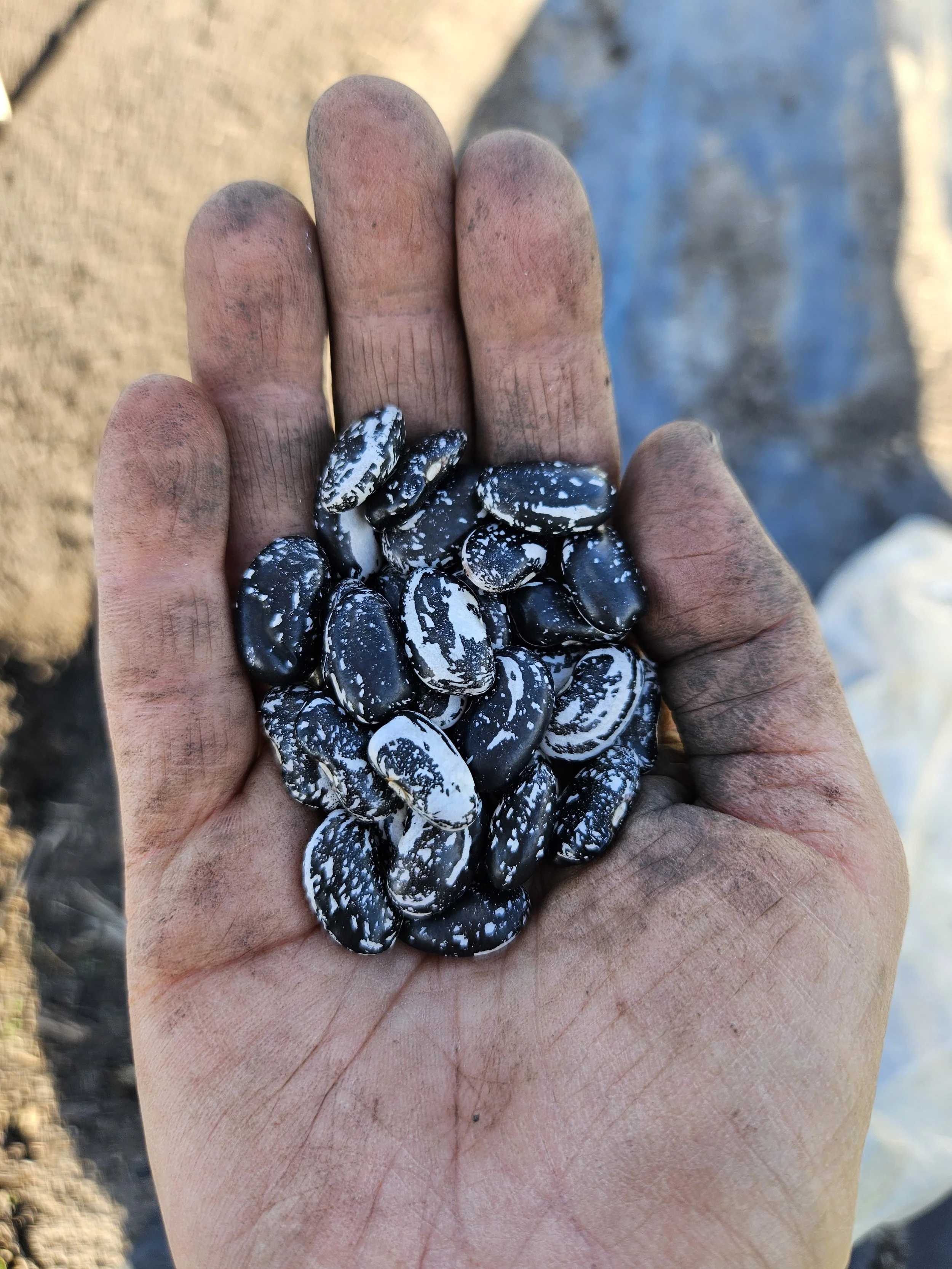
Beautiful heirloom beans
Are you intrigued by the idea of moon phase gardening? It's something that comes up every spring for me when I'm about to start planting or seeding things outdoors. It's an ancient practice, used and documented by cultures all over the world, including Indigenous people in North America. Biodynamic gardening also uses moon phases as a guide to planting and seeding. What does it involve?
Moon phase gardening says there are planting times during the moon's cycle that produce better results for different kinds of plants. Most of the folklore about moon or lunar gardening is about the moon's phases or the times when the moon is full and then waning, and the period when the moon is new and waxing (growing).
The basics of moon phase gardening are:
1) Plant annual flowers and vegetables that produce above ground during the new moon and waxing period. This includes things like tomatoes, cucumbers, zucchini, peppers and corn.
2) Plant perennial flowers and vegetables that produce below ground during the full moon and waning period. Potatoes, carrots, beets, onions. and other root vegetables.
Why would the moon phase matter?
The theory is the moon affects gravity and tides, so it also affects moisture in the soil. When the moon is growing or waxing, the tides are rising, the soil moisture is pulled to the surface, and your seeds will germinate better. The growing moonlight and gravitational pull also encourages plants to stretch and produce new leaves.
When the moon is waning, the moonlight is decreasing and plants are encouraged to grow good roots or tubers ( like potatoes).
To further complicate matters, one of my biodynamic gardening books says we should consider the moon's orbit around the Earth. You've probably heard the term "supermoon". When the moon is at its closest to the Earth, that's called its perigee. If this happens to line up with the full moon, we get a supermoon. When the moon is at its farthest from the earth, it's called the apogee. If the apogee lines up with a full moon, we get a "micromoon". Bryan O'Hara in 'No-Till Intensive Vegetable Culture' writes that when the moon is travelling towards the Earth, its beneficial effect on seeding is at its highest and germination should be good. If the moon is travelling away from the earth, the moon effect is minimal, so he suggests doubling the number of seeds sown.
Is there any scientific evidence behind this? Mostly no, but also yes. There is no evidence that a growing moon affects the moisture level at the soil's surface. Gravity from the moon affects oceans and even very large lakes, but there is no evidence it affects rivers, small lakes or the level of soil moisture.
Moonlight's effect on the plant is real. Plant leaves have been observed to rise and fall with the moon phase. Increasing moonlight gives a "pull" on the joint where a leaf meets the stem in the same way that sunlight does.
Here's the intriguing or freaky part: plants have a circadian rhythm. Just like people, their health is dependent on a natural internal clock that guides us. Things like flowering, resistance to temperature stress and pests, and seed production are all governed in part by a plant's circadian rhythm. A standard internal clock predicts 16 hours of light and 8 hours of darkness. How moonlight affects a plant's circadian rhythm and all the gene expression connected with it is being studied, but the logic is fairly clear. When the moon is bright or full, light is increased. When it's a new moon or a dark night sky, the light levels are low. Think of how a bright or dark night sky affects your own biological clock. I personally love the time around the new moon when the sky is dark. I sleep better and wake up feeling energetic. Are plants affected the same way? The research I read is super interesting but dense. If you’re into gene expression and photosynthesis, there’s lots to dive into.
The bottom line? If this information makes you feel anxious and like you're "doing it wrong", just plant your garden when you have the time. As a recovering perfectionist, I understand the urge to read ALL THE BOOKS, to research, and to use the best method possible. I'm in recovery from perfectionism because flower farming taught me that time is money and waiting for a moon phase ain't gonna happen!
Spring is short here in Alberta, and I don't have time to think about apogees and perigees. It's more, "Is there frost in the forecast?" When it comes to my home vegetable garden, I have a bit more time to think. I do follow the full moon and new moon for seeding and planting. Am I bananas? Maybe! I have also read enough now to know there is more emerging science behind what thousands of years of farming has noticed: the moon has some kind of power, even if we don't know exactly what it's doing.